

Most people trying to lose weight or build muscle focus on what they eat — but completely overlook how much they eat. That’s exactly the gap a good calorie calculator closes. The truth is, no matter how healthy your meals look on a plate, your body responds to energy balance above everything else. If you consistently eat more calories than you burn, you gain weight. Eat less, and you lose it. It sounds simple, yet millions of people struggle because they’ve never taken the time to calculate their actual daily calorie needs
The problem is not willpower. It is information. Without knowing your maintenance calories, your deficit, or your surplus, you are essentially flying blind — guessing portion sizes and hoping for the best. That is exactly the gap XenzFit is built to close.
In this guide, you will learn what calories actually are, how to calculate the right number for your goal, and how to use that number to build a sustainable fitness plan — whether you want to lose fat, gain muscle, or simply maintain a healthy weight.
What Are Calories?
A calorie is a unit of energy. Specifically, it measures how much energy your body extracts from the food and drinks you consume. Every biological function — from breathing and digestion to lifting weights and running — requires energy, and that energy comes from the calories you eat.
When people talk about “calories” in food, they technically mean kilocalories (kcal) — but the terms are used interchangeably in everyday life. A banana with “90 calories” contains 90 kcal of energy.
The three macronutrients and their calorie content
Protein — 4 kcal per gram
Carbohydrates — 4 kcal per gram
Fat — 9 kcal per gram
Alcohol also contributes calories (7 kcal per gram) but provides no nutritional value, which is why it is often called “empty calories.”
The common misconception
Many people believe that certain foods are “fattening” while others are “safe.” In reality, no single food causes fat gain or loss — total calorie intake over time does. A bowl of white rice is not inherently bad; it only becomes a problem if it pushes your daily total beyond what your body needs.
Why Knowing Your Daily Calorie Needs Matters:
Understanding your personal calorie target is the single most powerful thing you can do for your fitness results. Here is why:
Awareness: Most people underestimate how much they eat by 30–40%. Knowing your target creates an honest baseline.
Portion control: When you have a number to work toward, every meal becomes a deliberate decision rather than a guess.
Better planning: You can build meals, snacks, and even cheat days into your week without derailing your progress.
Consistency: Tracking calories — even loosely — is consistently shown in research to produce better long-term results than intuitive eating alone.
Flexibility: Once you know your numbers, you can eat any food you enjoy and still hit your goal. No food group is always bad.
The bottom line: calorie awareness does not mean obsessive counting. It means understanding your body well enough to make smarter choices every day.
How a Calorie Calculator Works:
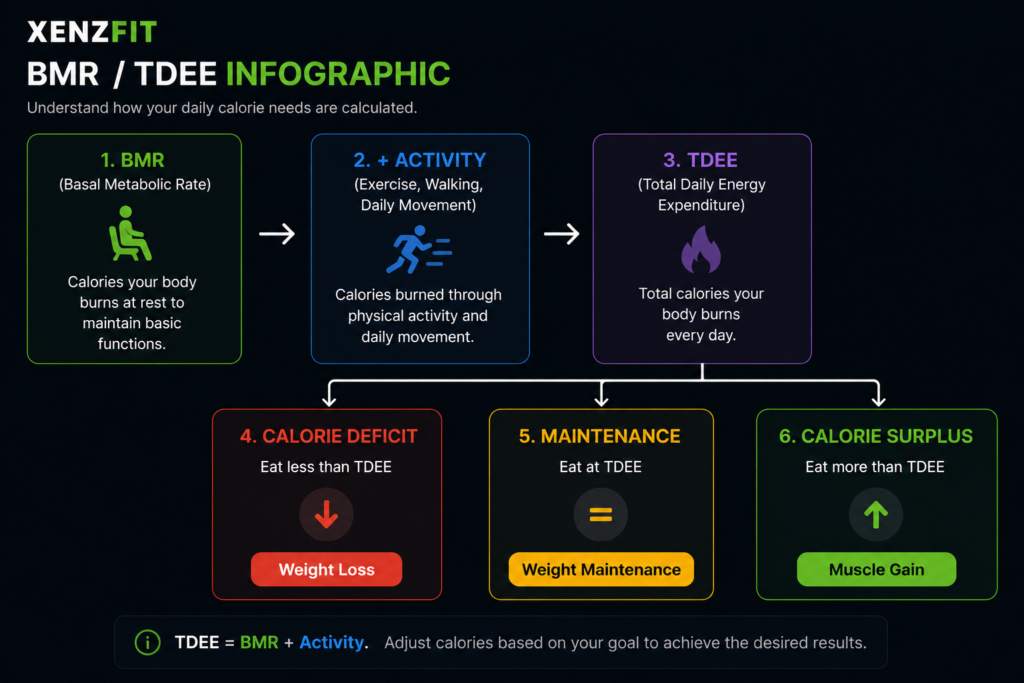
BMR, TDEE, and Energy Balance
A calorie calculator estimates your daily needs based on four inputs: your age, sex, height, weight, and activity level. Here is what happens under the hood.
Step 1 — Basal Metabolic Rate (BMR)
Your BMR is the number of calories your body burns at complete rest — just to keep your heart beating, lungs breathing, and organs functioning. It accounts for roughly 60–70% of your total daily calorie burn. BMR is calculated using scientifically validated formulas such as the Mifflin-St Jeor equation, which is considered the most accurate for most adults.
Step 2 — Total Daily Energy Expenditure (TDEE)
Your TDEE is your BMR multiplied by an activity multiplier that accounts for exercise, daily movement, and non-exercise activity (like walking, cleaning, or fidgeting). This gives you your maintenance calories — the number where your weight stays stable.
Activity Level Guide
Sedentary (desk job, little movement): BMR × 1.2
Lightly active (light exercise 1–3 days/week): BMR × 1.375
Moderately active (exercise 3–5 days/week): BMR × 1.55
Very active (hard exercise 6–7 days/week): BMR × 1.725
Extra active (physical job + daily training): BMR × 1.9
Step 3 — Adjusting for Your Goal
Once you know your TDEE, you adjust it based on what you want to achieve:
Fat loss: Subtract 300–500 kcal/day to create a deficit. This rate of loss equals roughly 0.3–0.5 kg per week — safe, sustainable, and muscle-preserving.
Muscle gain: Add 200–300 kcal/day above TDEE. This “lean bulk” approach minimises fat gain while providing enough energy for muscle growth.
Maintenance: Eat at TDEE. Ideal during diet breaks, recomposition phases, or when you are happy with your current weight.
Calorie Targets by Goal — Quick Reference
Use this table as a starting point. Your XenzFit calorie calculator will give you a precise number based on your personal stats.
Common Calorie Tracking Mistakes (And How to Fix Them)
Even people who track their calories regularly make these errors. Avoid them and your results will come faster.
Eating too little. Dropping below 1,200 kcal (women) or 1,500 kcal (men) triggers muscle loss and metabolic slowdown. A moderate deficit is always more sustainable. Fix: Set your deficit to no more than 500 kcal below TDEE.
Ignoring protein. Without enough protein, a calorie deficit causes you to lose muscle alongside fat. Fix: Aim for 1.6–2.2 g of protein per kg of bodyweight daily.
Tracking only weekdays. Weekend meals can easily wipe out a week’s deficit if unaccounted for. Fix: Track all 7 days, or at least be mindful on weekends.
Not measuring liquids. Juices, chai with milk, lassi, and cooking oil are high-calorie and often forgotten. Fix: Log every drink and use a kitchen scale for oils.
Following extreme diets. Crash diets may show quick results but always lead to rebound weight gain. Fix: Aim for slow, steady progress — 0.5 kg per week maximum.
Calorie Myths — Debunked
Myth 1: “Carbs make you fat”
Reality: Excess calories make you fat — not carbs specifically. Carbohydrates are your body’s preferred energy source. Rice, roti, and oats are perfectly fine in the right quantities. The problem is eating them in quantities that exceed your calorie needs.
Myth 2: “Eating less is always better”
Reality: Eating far too little is counterproductive. When calories drop too low for too long, your body reduces its metabolic rate, breaks down muscle for fuel, and makes fat loss progressively harder. A small, consistent deficit beats starvation every time.
Myth 3: “All calories are equal”
Reality: While calories determine weight change, the source of those calories affects everything else — energy levels, hunger, muscle retention, and health markers. 500 kcal of chicken and vegetables will serve your body very differently from 500 kcal of biscuits. Hitting your calorie target with nutrient-dense food is always the goal.
Myth 4: “You need to count calories forever”
Reality: Tracking is a learning tool, not a lifelong sentence. Most people who track consistently for 3–6 months develop an intuitive sense of portion sizes and calorie density that lasts for years — even without an app.
How XenzFit’s Calorie Calculator Helps You Hit Your Goals:
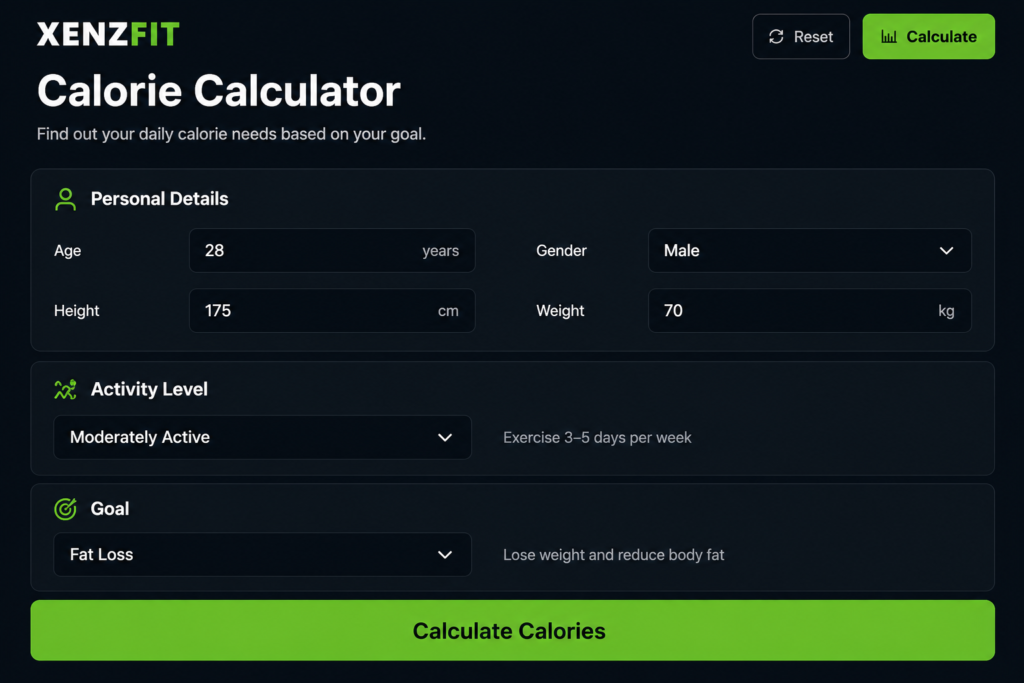
Calorie Calculator — Enter your age, weight, height, and activity level to get your personalised TDEE and goal-specific calorie targets in seconds.
 Macro Tracker — Once you have your calorie target, XenzFit breaks it down into the right protein, carb, and fat split for your specific goal.
 Indian Food Database — Search over 900 Indian foods including dal, sabzi, biryani, idli, and dosa — with accurate calorie and macro data for realistic meal tracking.
 AI Meal Planner — Get a personalised weekly meal plan built around your calorie target, food preferences, and budget.
 Goal Tracking — Set your target weight and timeline, and XenzFit adjusts your daily calorie recommendation as your weight changes.
Frequently Asked Questions
Q1. How many calories should I eat per day?
The right number depends on your age, sex, height, weight, and activity level. On average, adult women need 1,800–2,200 kcal/day and adult men need 2,200–2,800 kcal/day — but these are rough estimates. Use XenzFit’s calorie calculator to get a personalised number based on your exact stats and goal.
Q2. What is the best calorie deficit for weight loss?
A deficit of 300–500 kcal below your TDEE is the sweet spot for most people. This creates a loss of approximately 0.3–0.5 kg per week — fast enough to see progress, slow enough to preserve muscle mass and avoid metabolic slowdown. Deficits larger than 700–1,000 kcal/day are generally not recommended without medical supervision.
Q3. Can I lose weight without counting calories?
Yes — but it is harder. Strategies like portion control, eating more whole foods, cutting liquid calories, and following a structured meal plan can create a natural deficit without strict counting. That said, even loose calorie awareness significantly improves results compared to no tracking at all.
Q4. How much protein do I need per day?
For general fitness, aim for 1.2–1.6 g of protein per kg of bodyweight. For active muscle building, 1.6–2.2 g/kg is the evidence-based range. At 70 kg, that means roughly 112–154 g of protein daily. XenzFit’s macro calculator sets your protein target automatically based on your goal.
Q5. What is TDEE and how is it different from BMR?
BMR (Basal Metabolic Rate) is the calories your body burns at complete rest. TDEE (Total Daily Energy Expenditure) adds in all activity — exercise, walking, daily tasks — to give you the total calories you actually burn in a day. Your calorie target should be based on TDEE, not BMR.
Q6. Do calorie needs change as I lose weight?
Yes. As you lose weight, your BMR decreases because your body is smaller and requires less energy to function. This is why progress often slows after the first few weeks. XenzFit accounts for this by recalculating your target as your weight changes, so you always have an accurate number.
Q7. How accurate are online calorie calculators?
A good calorie calculator using the Mifflin-St Jeor equation is accurate to within 10% for most people. That is close enough to produce consistent results. The more important factor is logging your food consistently — even small daily errors in tracking outweigh any formula imprecision.
Q8. Is calorie tracking suitable for Indian diets?
Absolutely. The principles of energy balance apply universally. The challenge with Indian diets is that many traditional foods — like homemade dal, sabzi, and rotis — are not always in generic calorie databases. XenzFit’s Indian food database solves this with accurate data for 900+ Indian dishes, so you can track without guessing.
Q9. How many calories should I eat to build muscle?
To build muscle, you need a calorie surplus — typically 200–300 kcal above your TDEE. Paired with adequate protein (1.6–2.2 g/kg bodyweight) and progressive resistance training, this supports lean muscle gain while minimising fat storage. Larger surpluses lead to faster fat gain without meaningfully faster muscle growth.
Q10. What happens if I eat exactly at maintenance calories?
Eating at maintenance (your TDEE) keeps your weight stable. It is an excellent strategy during a diet break, when recovering from illness or injury, during high-stress periods, or when you are happy with your current weight and want to focus on building fitness performance rather than changing body composition.
Conclusion
Understanding your daily calorie needs is not about obsessing over numbers — it is about giving yourself the information to make smarter decisions. Whether your goal is to lose fat, build muscle, or simply feel better in your body, energy balance is the foundation everything else is built on.
You do not need a complicated diet or extreme restriction. You need a starting number, a clear goal, and a simple system to track your progress. XenzFit gives you all three and fast.Contact