

The importance of hitting your macros is no news to you. However, have you ever found yourself eating the appropriate number of calories but feeling tired, having trouble building muscles, and even losing muscles rather than fat? In case you answered yes, the thing you were missing is definitely your macros.
Macros stand for macronutrients that are protein, carbohydrates, and fats making up all your calories. Depending on the proportion you take your macronutrients, your body composition, energy levels, training, appetite, and even recovery will be affected.
Even though two individuals eat the same amount of calories, the results may be entirely different depending on how they take their macros.
With XenzFit’s macro calculator, you do not need to think about this anymore since we will provide you with your daily targets of proteins, carbs, and fats you need. Here you will learn everything you should know about macros and how to use them.
Here’s something nobody tells you when you first start tracking food: calories are only half the story.
I’ve watched people eat at a perfect deficit for three months, step on the scale, lose 8kg — and still look basically the same. Softer, actually. Smaller, but not lean. That’s what happens when you obsess over calories and ignore what those calories are made of.
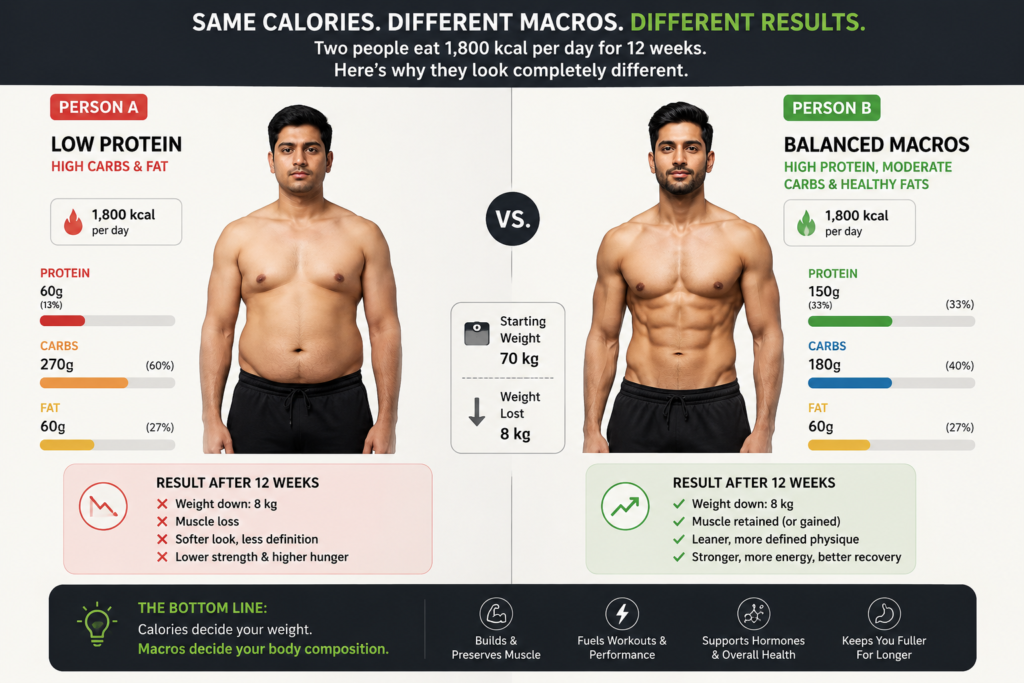
Macronutrients — protein, carbs, fat — are what determine whether you lose fat or muscle, whether your workouts feel strong or absolutely terrible, and whether you’re constantly hungry or actually satisfied. Two people can eat 1,800 calories a day and get completely different bodies out of it. The macro split is why.
So what actually are macros?
Three things make up every calorie you eat:
Protein (4 kcal/g) is the one most people undereat and then wonder why they’re losing muscle instead of fat. It builds and repairs muscle tissue, keeps you full longer than anything else, and your body actually burns more calories digesting it than it does digesting carbs or fat. Chicken, eggs, dal, paneer, Greek yoghurt, fish, tofu — that’s your protein toolkit.
Carbohydrates (4 kcal/g) are your body’s preferred fuel — especially your brain and your muscles mid-workout. They get stored as glycogen and get pulled out when you’re pushing hard. Carbs got a terrible reputation for no good reason. The issue was never carbs; it was eating too many calories overall. Rice, roti, oats, fruit, legumes — none of these are the enemy.
Fat (9 kcal/g) is the calorie-dense one, which is why people cut it first. That’s usually a mistake. Fat is essential for hormone production — testosterone, estrogen, the whole system — as well as absorbing vitamins A, D, E, and K. Cut fat too low and your energy tanks, your mood tanks, and your progress stalls. Ghee, nuts, seeds, avocado, fatty fish — eat them.
Why this matters more than just hitting your calorie number
Pure calorie tracking answers one question: will I gain or lose weight? Macros answer the better question: what will I gain or lose?
Without enough protein in a deficit, your body starts cannibalising muscle for energy. You get smaller but not leaner. It’s the most common reason people are disappointed after a cut.
Without enough carbs, your workouts suffer. You can’t train as hard, you recover slower, you build less muscle. The whole point of training gets undermined.
Without enough fat, hormones go haywire. For men, testosterone drops. For women, estrogen cycles get disrupted. Neither outcome helps body composition or mood.
Protein and fat both slow digestion significantly, which is why a properly structured macro split makes staying in a deficit feel manageable instead of miserable. You’re not white-knuckling it through hunger — you’re just… not that hungry.
How a macro calculator actually works
Step one is figuring out your TDEE — Total Daily Energy Expenditure — which is how many calories your body burns in a day at your current activity level. That number is your anchor.
From there, the calculator adjusts based on your goal: a deficit for fat loss, a surplus for muscle gain, or maintenance if you’re happy where you are and just want better body composition over time.
Then it splits those calories across protein, carbs, and fat using ratios that are matched to your goal. Protein gets set first based on your bodyweight, fat gets a floor to protect hormones, and carbs fill the rest.
Protein targets by goal, for reference:
Fat loss: 2.0–2.4g per kg of bodyweight (higher because you’re protecting muscle in a deficit)
Muscle gain: 1.6–2.0g per kg
General fitness: 1.2–1.6g per kg
A 70kg person in a fat loss phase needs roughly 140–168g of protein daily. That’s a meaningful number to build a diet around.
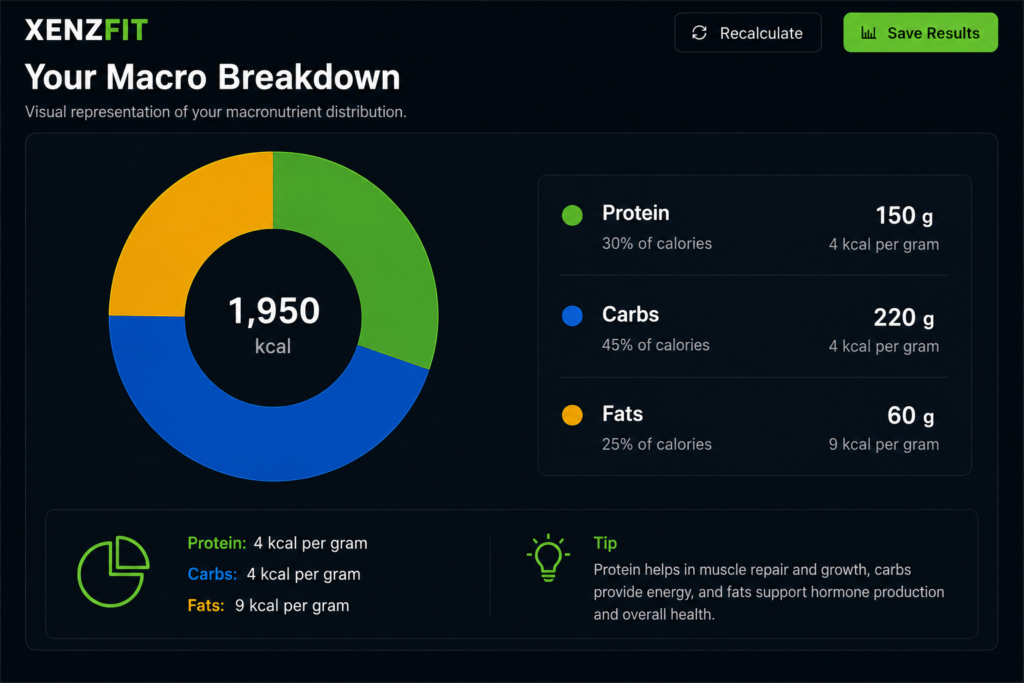
Macro splits by goal
IIFYM — the flexible dieting approach that actually works long-term
IIFYM stands for “If It Fits Your Macros.” The idea is simple: no food is banned. No meals are off-limits. As long as your daily protein, carb, and fat totals line up with your targets, you’re on track.
In practice: you’ve got 40g of carbs left at 9pm. A banana fits. A small bowl of rice fits. A couple of biscuits fit. None of those choices will hurt your results. What matters is the total, not the individual food choice.
This isn’t a licence to eat processed junk all day. The 80/10 rule is worth following — 80–90% of your diet from whole, nutrient-dense food, and the flexibility for the remaining 10–20%. IIFYM works precisely because it doesn’t require perfection. And sustainable beats perfect every time.
Mistakes that kill progress
1. Setting protein too low. Almost universal. People estimate roughly and end up 50–70g short. In a deficit, that shortfall comes directly out of muscle mass.
2. Cutting fat to near zero. Feels logical since fat has 9 kcal/g. Goes badly. Drop below 15–20% of total calories from fat and hormone production starts degrading.
3. Stressing about the ratio instead of the total. If you hit 95% of your protein but went 5% over on carbs, your results won’t suffer. Chasing perfect ratios at the expense of consistency is a losing game.
4. Never recalculating. As your weight changes, your TDEE changes — which means your macro targets change. Recalculate every 4–6 weeks or whenever weight has shifted by 3–5kg. Stale targets are one of the main reasons progress plateaus.
5. Tracking protein but ignoring carbs and fat. All three macros carry calories. If you’re only tracking one, you’re not actually tracking macros — you’re just journaling protein.
A few myths worth killing
“Carbs at night make you fat.”
No. Your body doesn’t have a clock that decides to store fat after 7pm. Total daily calories over TDEE cause fat storage — not the timing. Eating carbs in the evening is fine. For many people, it improves sleep and next-day performance.
“More protein always means more muscle.”
There’s a ceiling. Above roughly 2.2g per kg of bodyweight, additional protein doesn’t build additional muscle — it just gets burned as energy or stored. Hit the optimal range consistently and stop maximising protein at the expense of carbs that actually fuel your training.
“Fat makes you fat.”
Excess calories — from any source — cause fat gain. Dietary fat is not uniquely fattening. Cutting healthy fats from ghee, nuts, and fish can actually slow fat loss by disrupting the hormonal environment your metabolism runs on.
“You need to eat every 2–3 hours to keep your metabolism running.”
Meal frequency has a negligible effect on metabolic rate. Total daily intake is what matters. Two meals or six — whatever suits your schedule and keeps you consistent.
What XenzFit’s calculator handles for you:
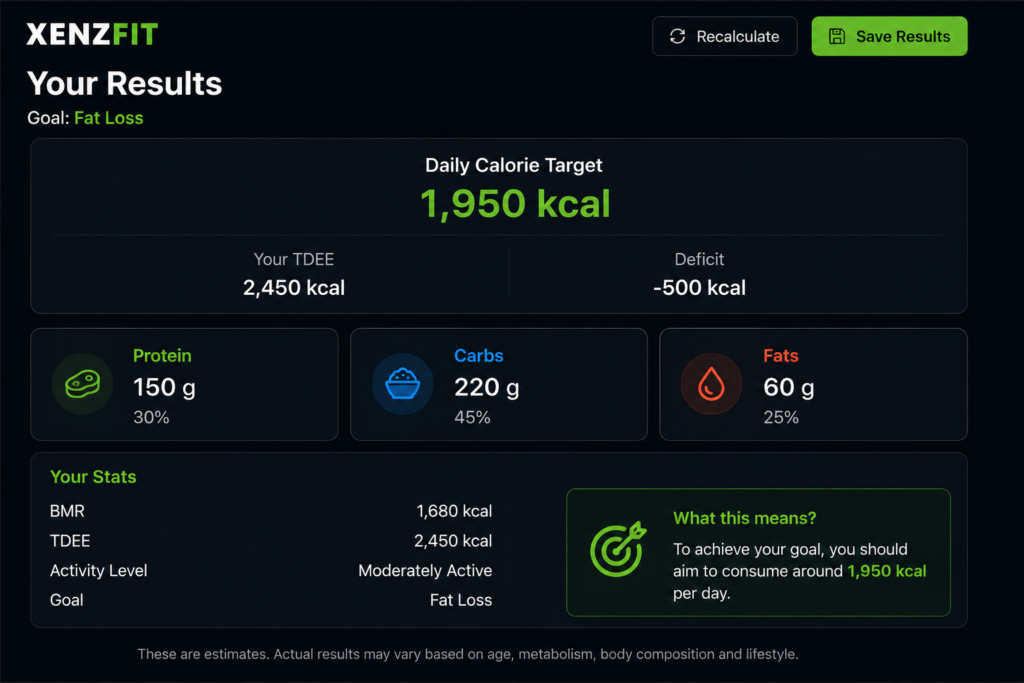
Doing this manually is tedious:
find your TDEE, calculate protein from bodyweight, set a fat floor, subtract both from total calories, convert the remainder to carb grams. It takes a while and it’s easy to mess up.
XenzFit runs through it instantly — enter your age, weight, height, activity level, and goal, and you get your protein, carb, and fat targets in grams. It also includes:
Goal-specific splits that switch automatically based on what you’re trying to do
An Indian food database with 900+ dishes — dal makhani, dosa, idli, rajma, chicken curry, the full range — with accurate macro data per serving
A meal planner that builds a weekly plan hitting your exact targets using food you actually eat
Daily logging with a weekly view of how your intake compares to your targets
FAQ
1. How much protein do I actually need?
For active people: 1.6–2.2g per kg of bodyweight. At the higher end if you’re in a deficit. At 70kg, that’s 112–154g daily.
2. Should I track net carbs or total carbs?
Total carbs for most goals. Net carbs (subtracting fibre) is a keto-specific concept. Unless you’re doing strict keto, track total.
3. Can vegetarians hit their protein targets?
Yes, though it takes more planning. Paneer, tofu, tempeh, dal, chickpeas, kidney beans, edamame, Greek yoghurt — these work. Combining sources across meals covers all essential amino acids.
4. Do macros matter more than calories?
Different jobs. Calories determine whether weight goes up or down. Macros determine whether that change is muscle or fat. Track both.
Calories are the quantity. Macros are the quality. Getting both right is what separates people who are frustrated after three months from people who actually look different.
You don’t need to hit every number perfectly every day. But having a target — a real one based on your body, not a generic split you found on Reddit — turns every meal from a guess into a deliberate step toward what you’re building.Contact